
Essay

Anatomy of a Soul Machine
a group show curated by Katya Austin at Shutter Gallery
the world is your oyster,
you can eat it through your screen
my body is a diagram,,
the blueprints hold the key
follow the path//
press the button//
self destruct//
get set free // / /
the machine is the body
silicone body sacrament on my tongue/
singularity samsara(-
someday we’ll all be One
. • ☆ . ° .• °:. *₊ ° . ☆° 。・ . • ☆ . ° .• °:. *₊ ° . ☆° 。・
My phone is my body, my camera my eyes,
my food my fuel, get in babe let’s drive
Go for a ride on the slick paved road,
the roads are the city’s veins and bones
Underneath the gravel the Earth’s clothes,
underneath the clothes the Earth’s flesh it glows
full of life with worms and bugs
The diagram of my body it turns to dust
My toothbrush will outlive me, this car’s gonna crash
The blueprints in my body they lead me to grass
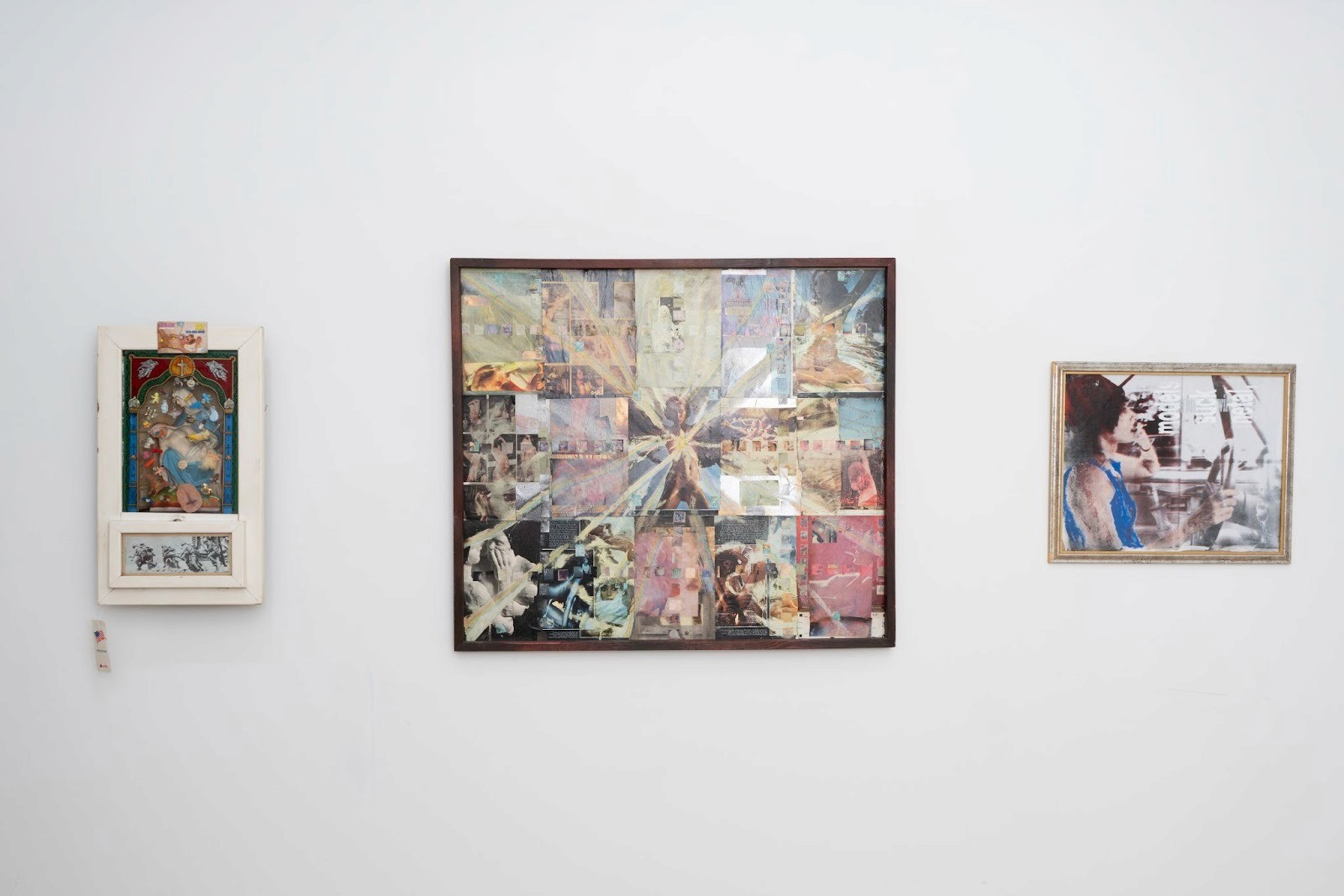
The Anatomy of a Soul Machine group show curated by Katya Austin at Shutter Gallery featuring works by Harley Jade Walker, Annabelle Weatherly, Brandon de la Sierra, Clay Devlin, Matthew Tully Dugan, Donna Dimitrova, Jack Wellman, and Naim Johnson is a collaborative exploration of what it means to be in a body that can connect to the Divine and to the internet.
The title of the show came when I was meditating at a Zen Monastery. Spirit, body, machines, mechanics, blueprints, diagrams, samsara, cycles, spirit, body, machines, mechanics, blueprints, diagrams, samsara, cycles, anatomy, anatomy, anatomy. I watched these words swirl in my mind, letting them pass in and out of my attention field, until finally the phrase came to be. It is the synthesis of all that has been on my mind for the past several years. What is spirit? What is body? What is technology? What is mind? What is soul? Where did we come from? Where are we going? Is this dusk or is this dawn? Chat, are we cooked? To explore these questions in depth requires embracing a variety of perspectives. I selected several artists whose work explores this realm of questioning, sent my poems as prompts, and asked for their interpretation. Each work in the show is a piece of the mosaic that defines the Anatomy of the Soul Machine.
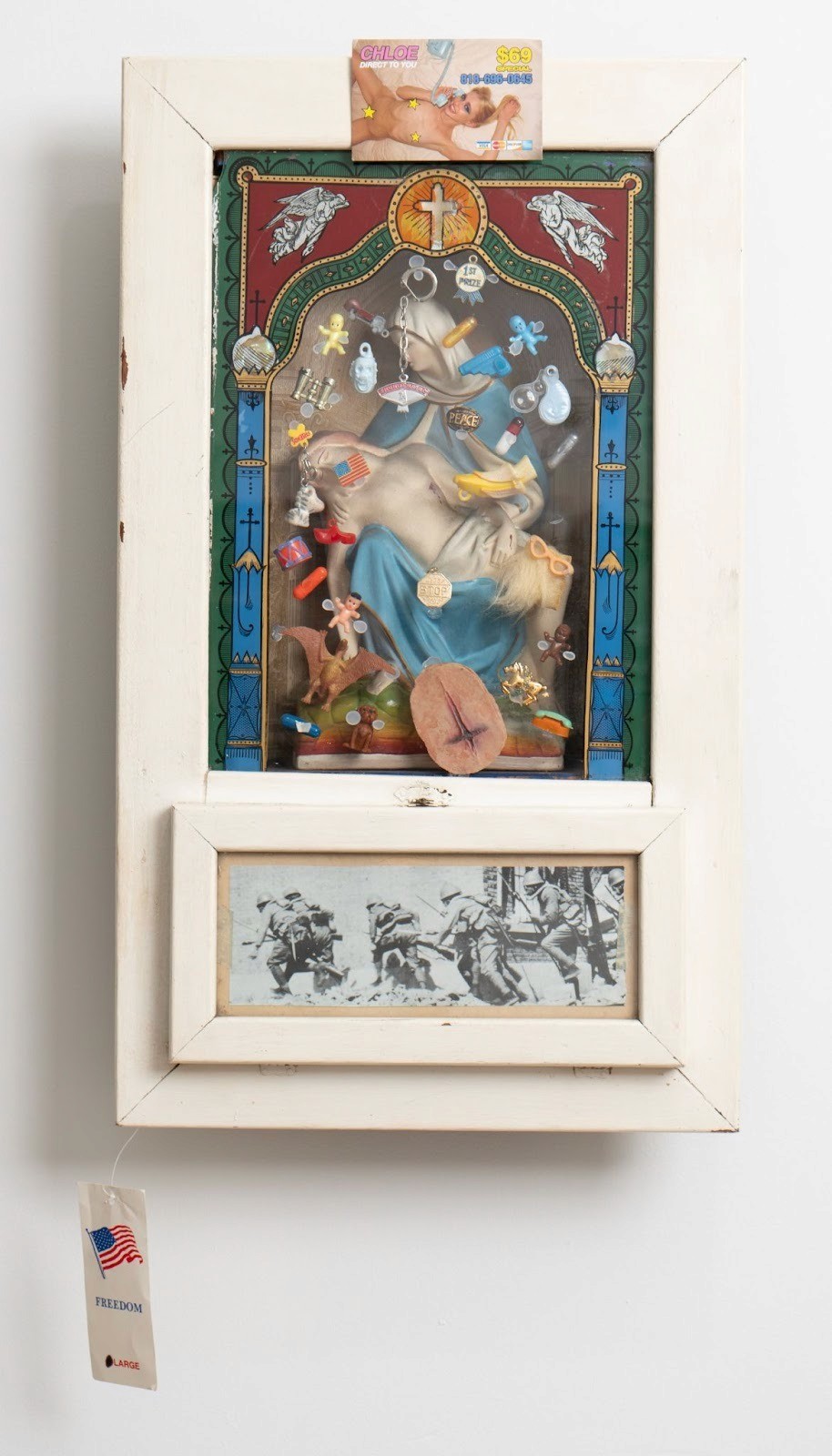
Harley Jade Walker’s Jesus and Mary Church Cabinet (2025) sets the stage. The found altar cabinet depicts Christ’s body held by the nurturing Mother Mary- a widely familiar depiction, surrounded by 25¢ toy machine souvenirs; small plastic babies, an American flag positioned right above Jesus's face, signs for peace, a dinosaur, a suggestively placed banana, a fake skin scar in the shape of a cross tilted downward. These caricatures act as an innocent-seeming layer that obscures the moment of reckoning. This scene’s foundation contains a framed image of soldiers in the midst of the Vietnam war, and pornstar Chloe Cherry’s business card on top. What hangs below this cabinet turned demented toy machine is a clothing tag that reads “FREEDOM” and the size “Large”. A portrait of a world in which men and women sell their bodies for freedom. Each detail in this cabinet of curiosities dissects the anatomy of the machine that runs on sex, war, plastic, and religion. An altar to the absurd. But hey, at least we get to worship play.
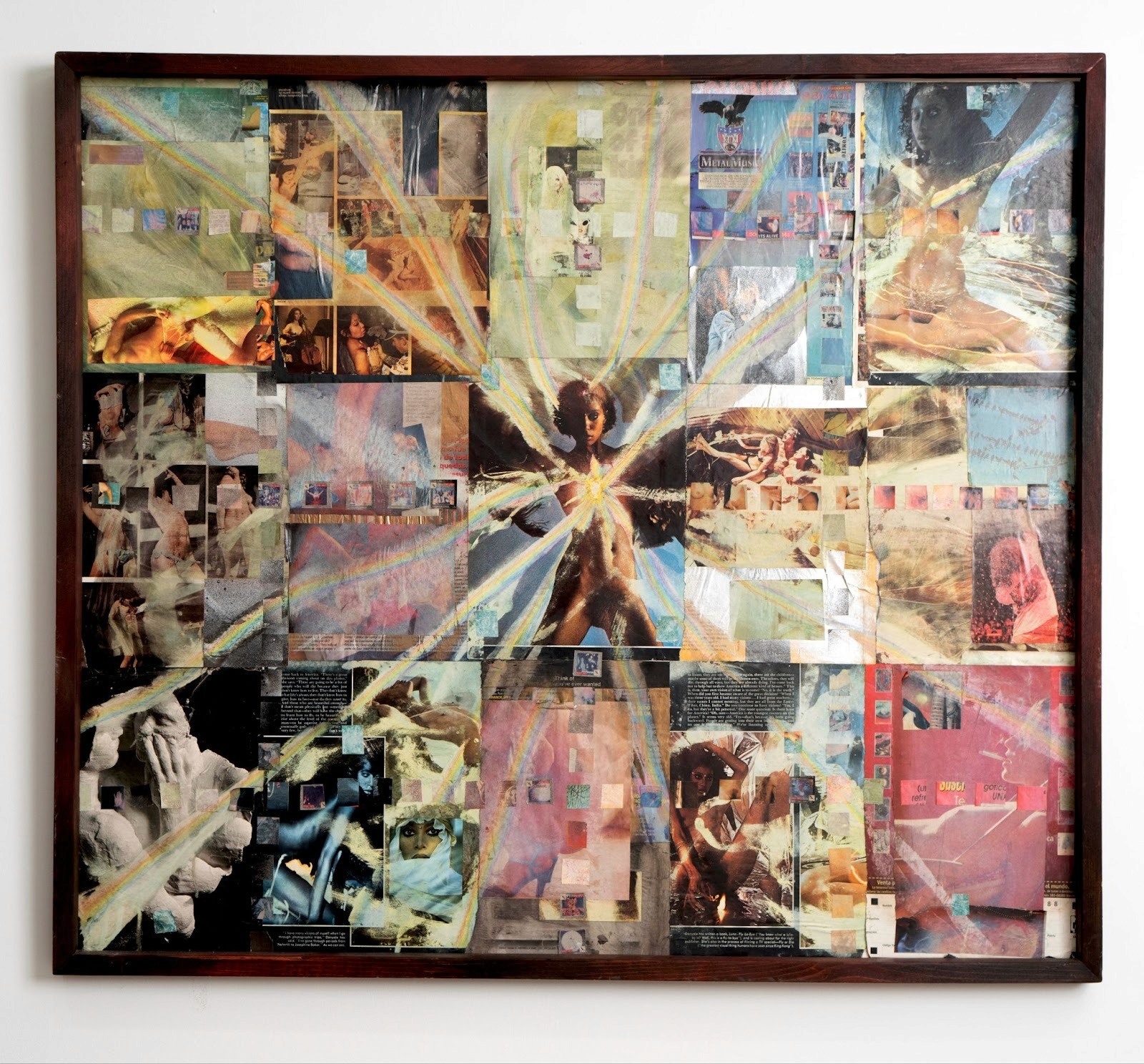
With Annabelle Weatherly’s Luna Star (2025), we move from wounded masculine to divine feminine. The spirit of consumption becomes the spirit of erotic power. The sheer force that emanates from the body of a woman who has transcended her wounds. The Luna Star is sliced open - metaphorically, metaphysically, and literally as this piece is made of collaged vintage Playboy magazines. Instead of blood, golden light pours out of her corporeal form. Her pain is transfigured into celestial lifeforce. At the center is Donyale Luna, a woman who was able to break through the racial limitations of the 1960s to become the first black supermodel to grace the cover of British Vogue. Luna believed in curating one’s reality through techniques such as deep visualization and gratitude. A fitting muse for Annabelle, who accesses new states of being through the process of creating her collages and embroidered tapestries. The sigils and symbols that populate the surface of her pieces are full of attention and intention. She has even credited her work as aiding in the success of her modeling career. Luna Star feels like a perfect artifact one uncovers underneath decades of advertisements on a subway wall. A piece that is equal parts chaos & order, creation & decay, spirit, body, & technology.
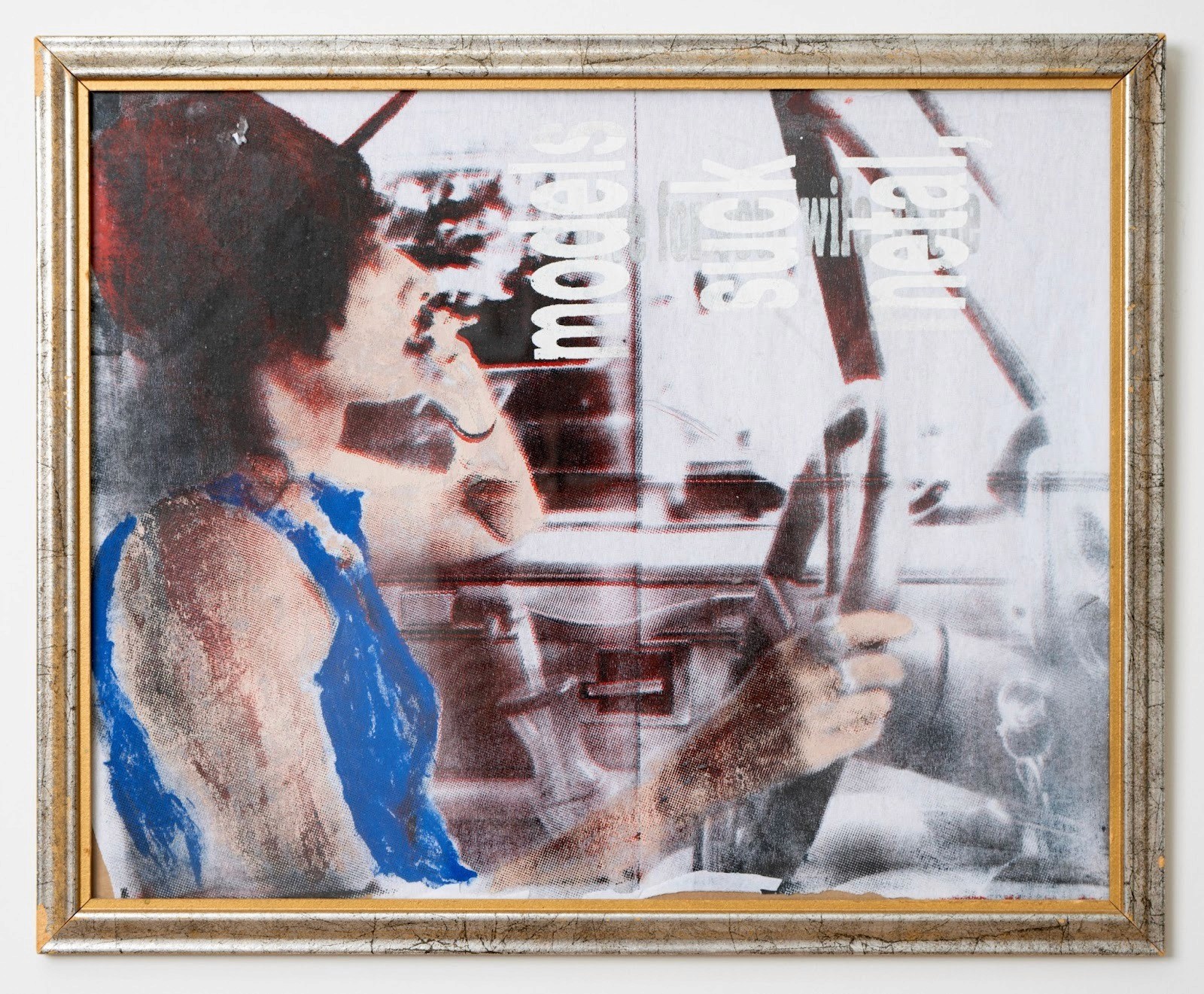
Driving away from the transcendental feminine is Brandon De La Sierra’s PELA VACA (2026). This photograph of Brandi Divine smoking the words “models suck, metal” layered over “live for your wife or die,” is screen printed onto a cotton t-shirt with handpainted colors. Brandi is a filmmaker and actress known for blurring the lines between when she is “in character” or not. In this moment she is embracing her masculine, contemplative, but nonetheless moving forward. Or perhaps escaping? The piece is named after the truck Brandi bought for cash from strangers on the street which allegedly belonged to Chalino Sanchez, the iconic Mexican singer who was handed a death threat on stage from the cartel for singing in Sinaloa. There is a famous video of Sanchez reading this note, swallowing the truth, and continuing the show. He was found dead the next day with two gunshot wounds in his head. Brandon’s main mediums are photography and screenprinting. The phrase “models suck, metal” is a combination of Davide Sorrenti’s “Models Suck” and a reference to “Death Metal, Florida” which is Brandon’s pseudonymous brand. Underneath the bolded phrase is “live for your wife or die,” a mixture of David Lynch’s “fix your hearts or die” combined with Brandon’s reverence for the love shown to Larissa Shepitko by her husband who made a documentary about her life and work. Brandon’s ability to weave together cultural references and an appreciation for the cinematic every day moment allow him to create pieces that hold enormous weight, with or without the depth of context.

Harley Jade Walker’s series of polaroids depicting intimate scenes from the years 2021-2022 arranged in a cross are contextualized into a personal mythology. The names of each snapshot create a poem of sorts. Jesus Tee (2021) anchors the center of the cross in humour and absurdity. Infinite Love, (2021) and Wax Drip (2022) extend the anatomy of the cross, the body as the site of devotion. Eden in the Poconos (2022) evokes paradise in the ephemeral light. Milano Bricks (2022) honors the sacred in the urban. Soleil and her Bunny (2022) is tenderness. Together they form a body that holds the memory of Harley’s life. This affectionate cross stands in contrast to her Jesus and Mary Church Cabinet, sandwiching Luna Star and PELA VACA. A reclamation of the shape that evokes sacredness in the psyche. A shape that has been used as a tool for control and oppression. A symbol of personal sovereignty and the essence of her devotions.
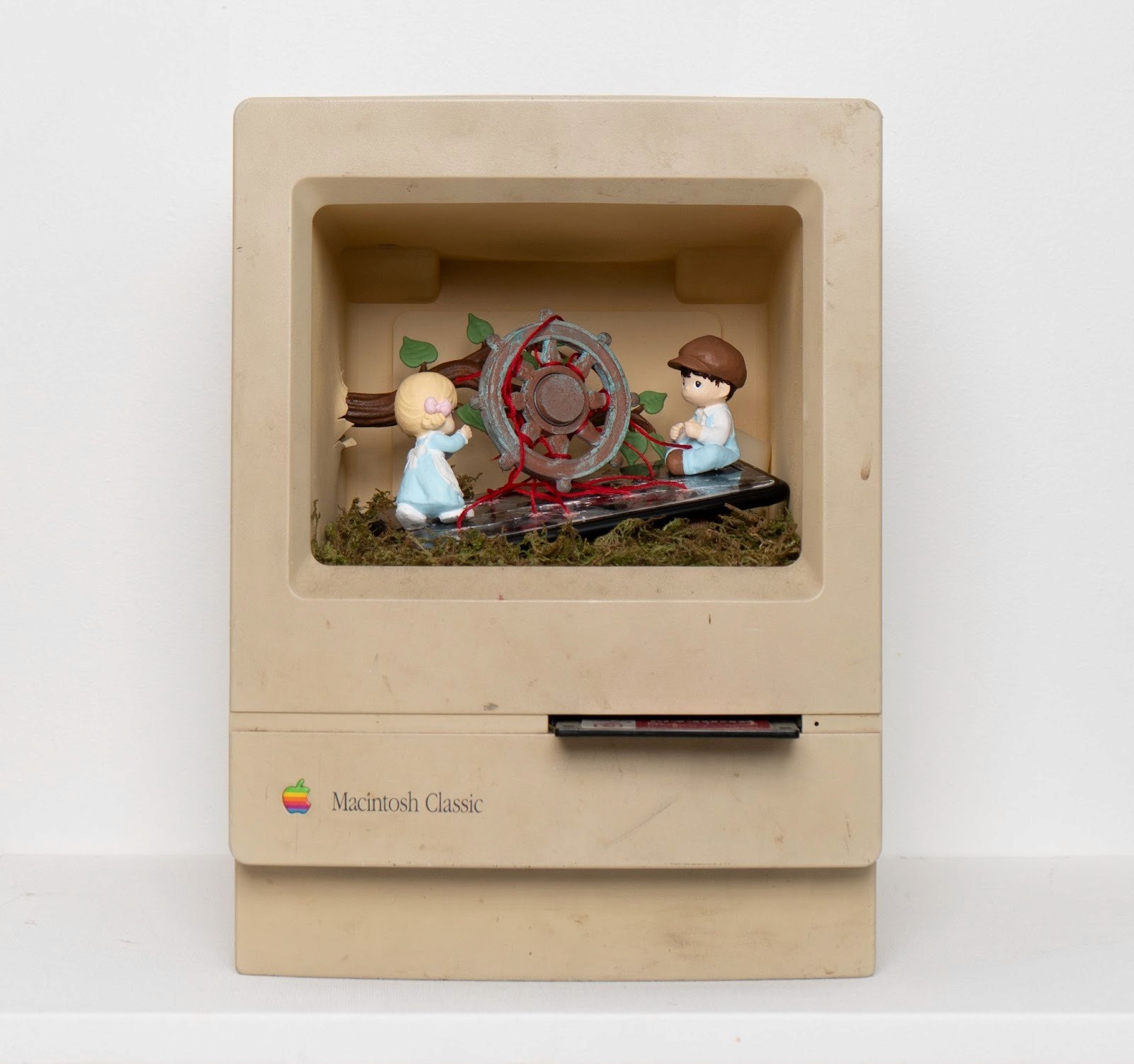
Clay Devlin’s MEANS OF ATTENTION (2026) is a sculpture made out of a 1991 Macintosh Classic, with a tree branch breaking through the left side. In front of the branch sit two figurines, a small boy and girl, atop an iPhone 7. There are 8 red strings coming out of the screen wrapped around a fidget spinner meant to represent the Dharmachakra wheel in Buddhist mythology. A DOOM screensaver sits in the port of the computer. All of these elements come together to explore the impact the attention economy is having on our bodies and minds. The way our attention and desire for connection is being hijacked by corporations with profit incentives that neglect our health and make it hard to live life by the righteous eightfold path; right understanding, intention, speech, action, livelihood, effort, mindfulness, and concentration. During the Sunday Salon on March 1st, Clay invited eight audience members to come and cut the chords between the phone wrapped around the wheel. An invitation for all of us to cut our addictions and dependence on the dopamine found within the screen. This sculpture is a departure from Clay’s usual artistic practice, which is digital in nature and involves creating beautiful visuals out of code with p5.js. Clay is also a highly regarded member of the digital art world and is known for his taste in curation. Even though much of his practice is digitally-based, he has a deep awareness of the importance of balance between the digital and the physical.
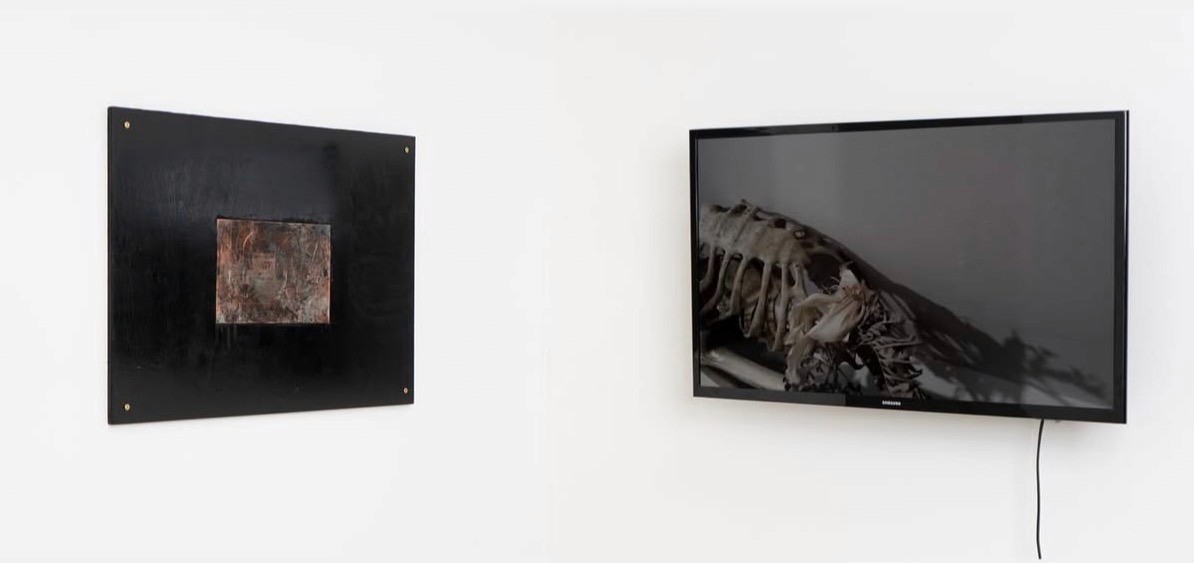
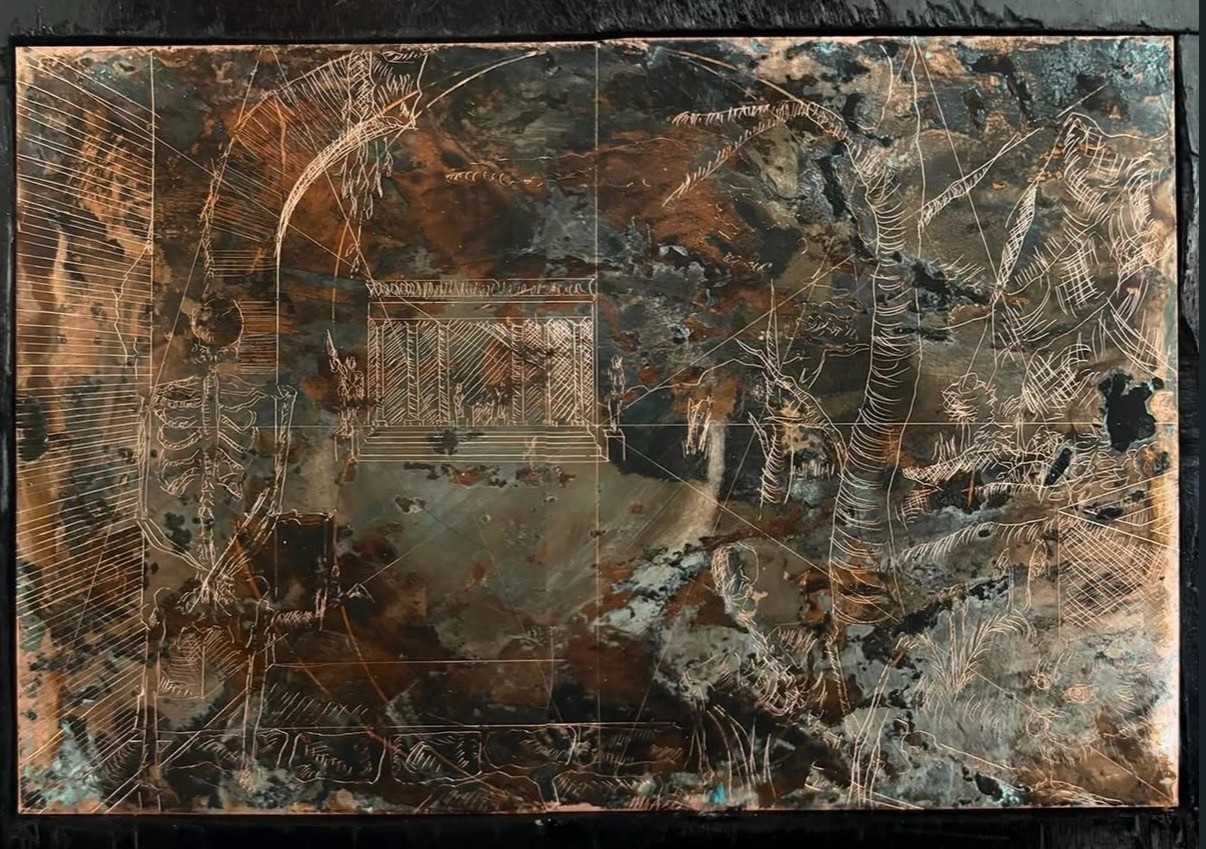
Matthew Tully Dugan’s diptych EndX2026.1, and LIVE DEAD (2026) is an exploration of ancient and modern processes. On the left, a copper plate with an etching of a scene using harmonic symmetries. The graphite used for the etching was handmade from a 17th century recipe using damar crystal, palo santo, charcoal and pitch, myrrh resin, refined white wax, and linseed oil.
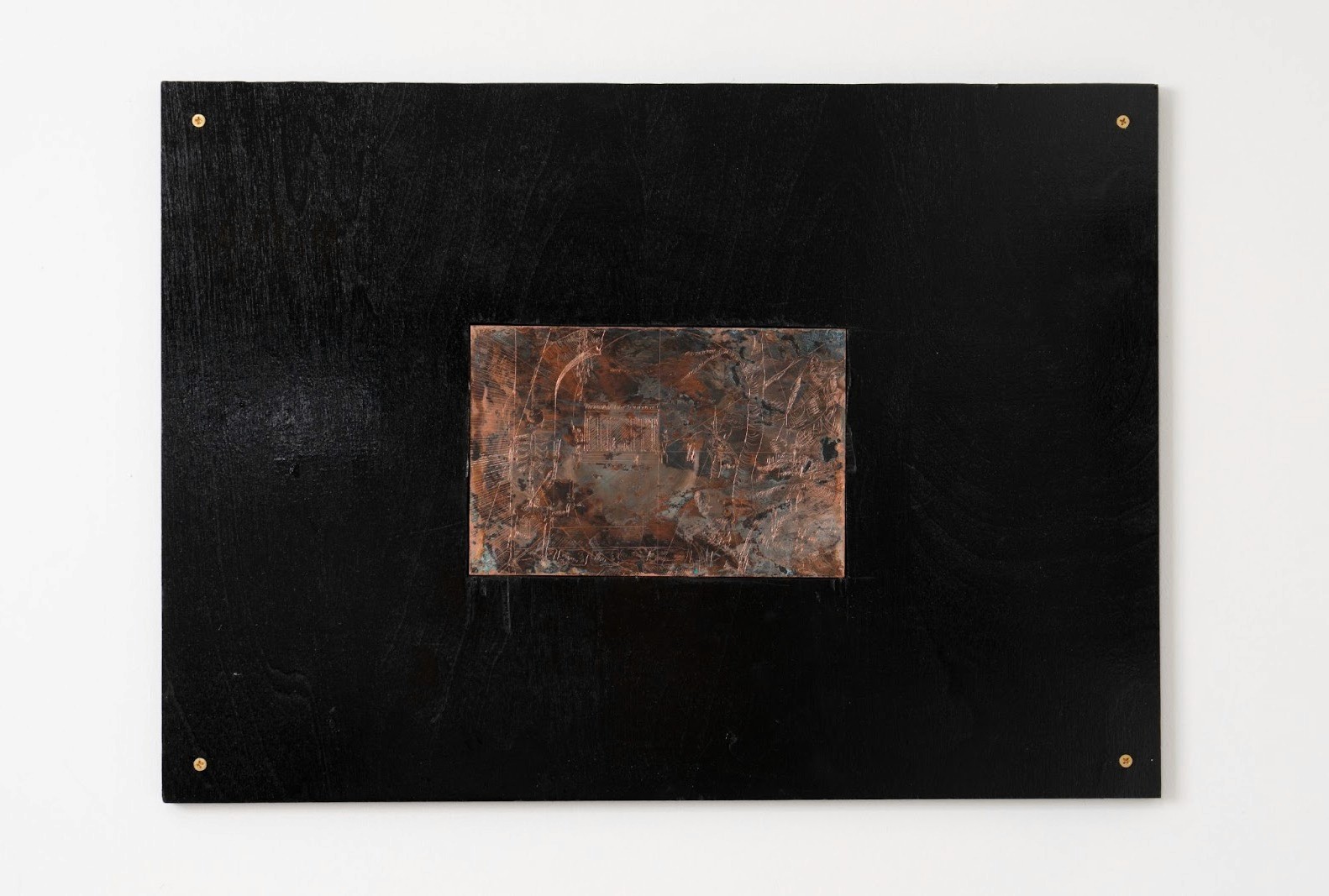
The copper plate was dipped in a bath of peroxymonosulfuric acid, ammonia, boric acid, vinegar, sea salt, urea (phosphate) sodium bicarbonate, and hydrogen peroxide to force the patina and it give a deeply aged look. The frame was coated with cuttlefish ink. On the right is a tv monitor that displays a 24 hour livestream from the inside of what seems to be a crypt containing a still life of rib cage bones and decaying flowers.
Tully is a self taught artist who spends much of his time in libraries, studying anatomy, drawing and painting practices, recipes from the Middle Ages, and also immersing himself in the cutting edge of new media. His muses are Caravaggio and Kai Cenat. Tully is one of those rare artists that engages with social media with the same respect, curiosity, and eagerness to push the boundaries as any of the other fine arts.
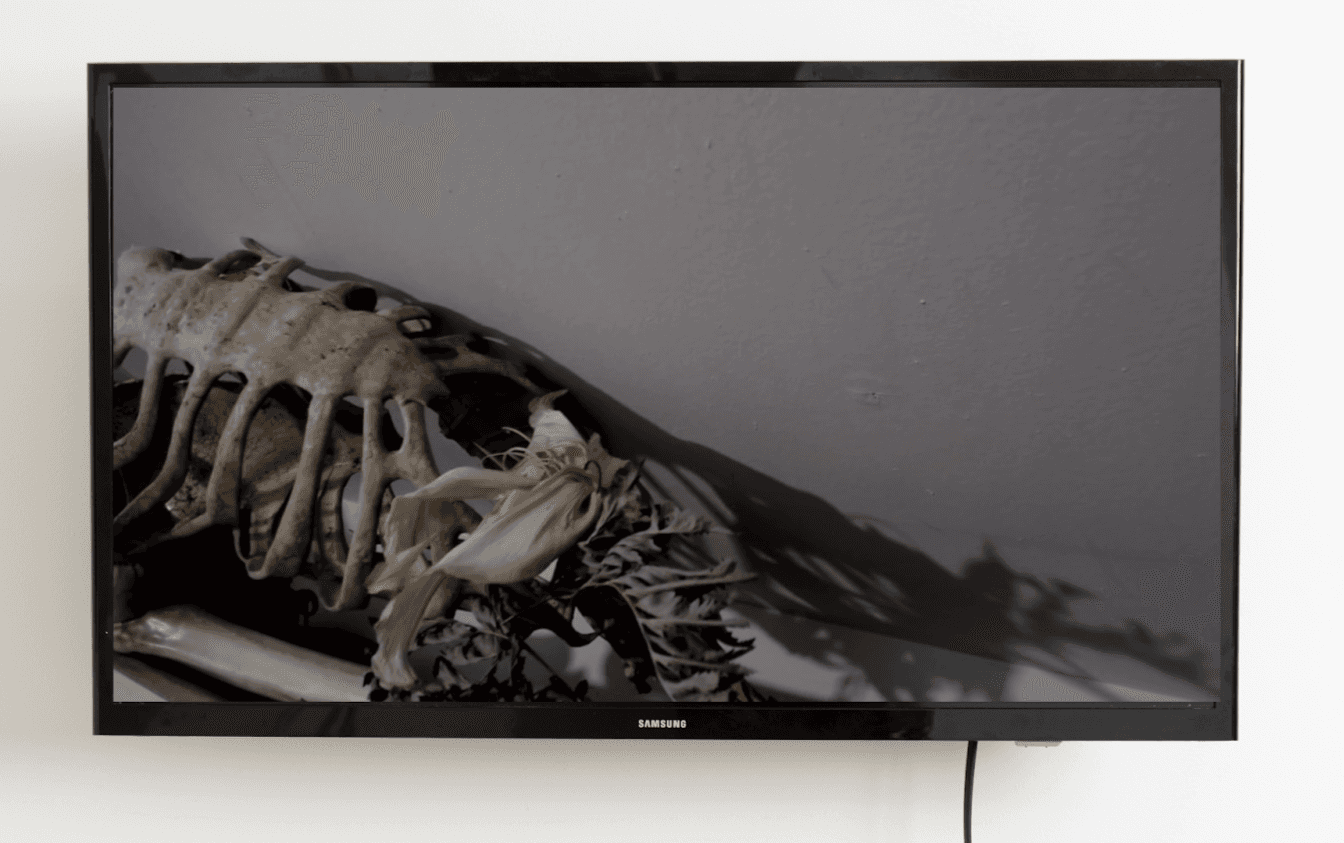
With this diptych, Tully condenses centuries of aging into mere hours of work, and expands a single moment into a perpetual 24 hour performance that repeats day after day after day until the subject matter turns to dust or the internet finally goes out.
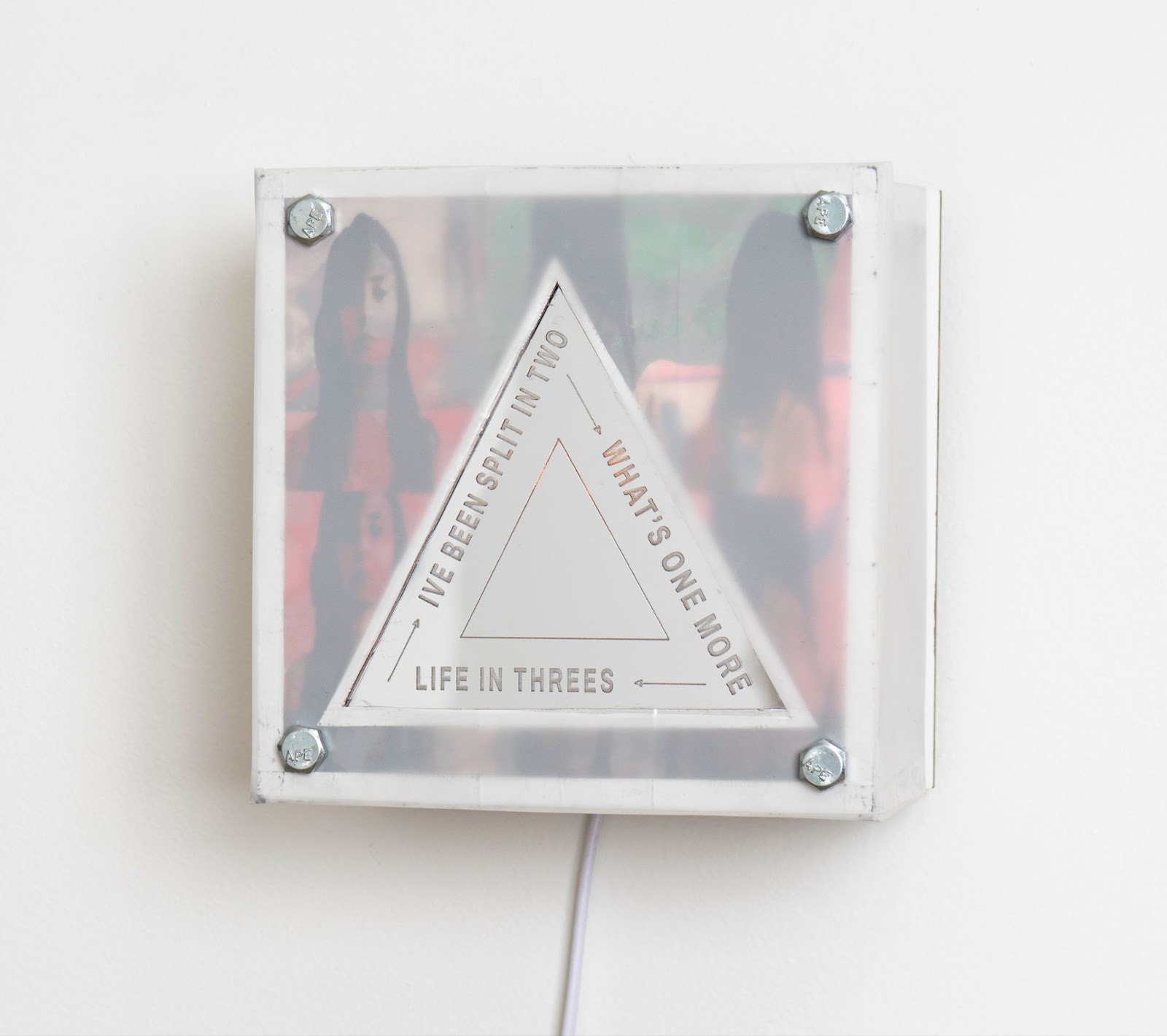
Donna Dimitrova’s LIFE IN THREE’S (2026) is a sculpture of a box with a lightbulb inside that illuminates a paper collage of her self portraits surrounding a triangle-shaped mirror with the phrase “I’VE BEEN SPLIT IN TWO → WHAT’S ONE MORE → LIFE IN THREES →”. Donna’s split image, facing forward and facing away, observes the audience as the audience looks themselves in the eye. However there are only two pairs of portraits, suggesting an invisible third, or perhaps the audience as the third. In this piece Donna is the light source. She’s been split apart but she’s not been made less whole. It is reminiscent of Donyale Luna’s essence pouring out of her split body in Annabelle Weatherly’s Luna Star. Once again, the woman who has endured the split is often also the woman whose light shines strongest. A woman who shines bright is also inevitably observed. She invites the audience to see her, and in the process, they must look themselves in the eye. They must come face to face with their own light, or lack thereof. Much of Donna’s work has to do with combining fine art techniques and electric circuitry. Paintings that glow when they are touched, platforms that rotate as stages for performance. Donna constantly invites the audience to interact with her work, shrinking the space between object and observer. Her work holds the reality that our bodies and our silicone run on the same electricity; that love and lightning are made of similar essence.

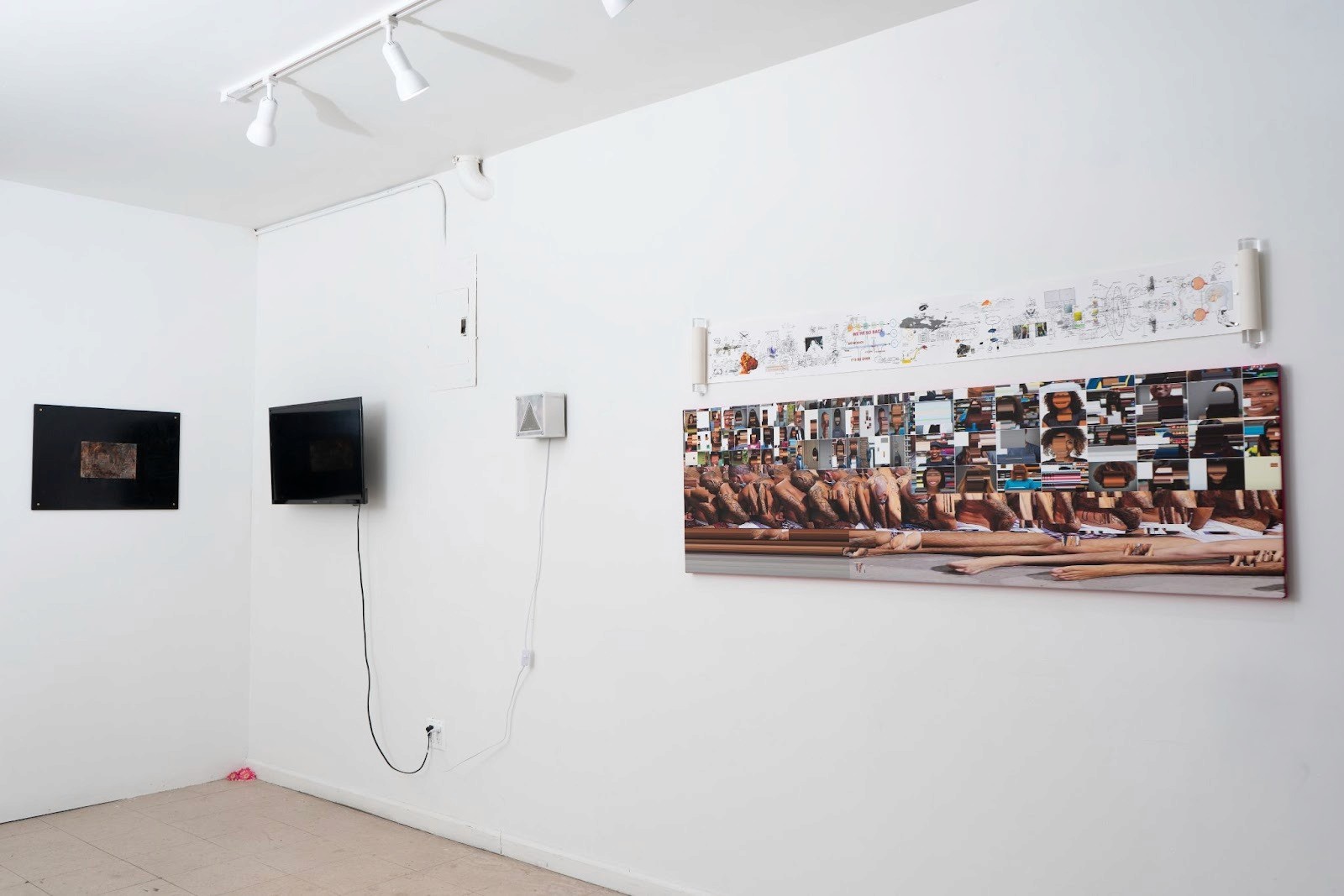
Jack Wellman’s MONDAY SCROLL (2026) is the anatomy of the mind of a blackpilled schizo voidmaxxed hyperwired thoughtcell processing the reality of the military industrial complex and all of the psyops that exist in parallel. Printed on canvas and presented on an actual scroll. It’s so over.
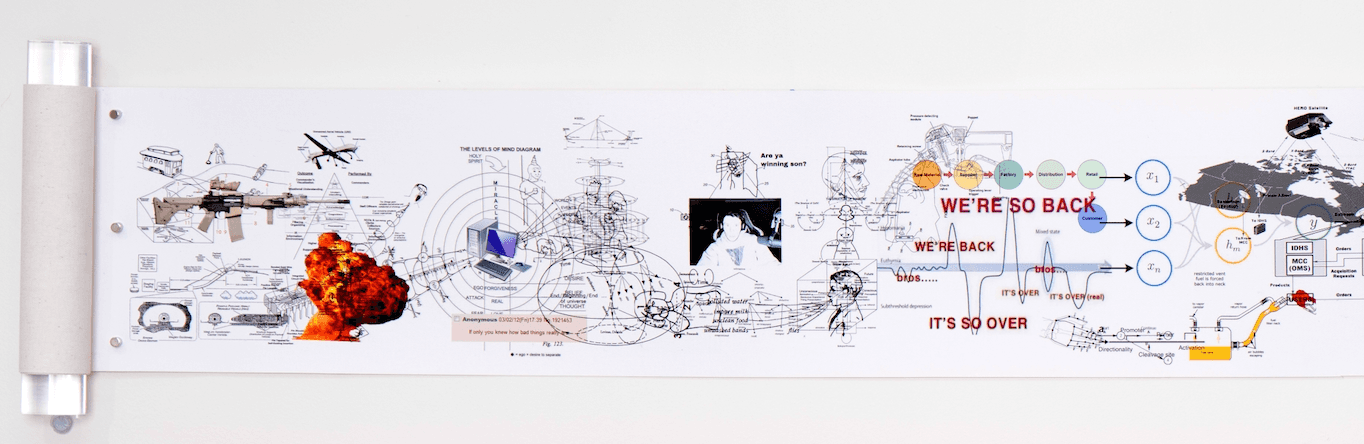
Jack represents something new, the first generation of artists who grew up in the algorithm. The kids who grew up truly online are finally old enough to be making thought provoking fine art, and pushing the boundaries of what exactly “fine art” is going to be in this era. In light of the impending war with Iran and the perpetual fear of a true WW3 breaking out, it makes sense that Jack, who is the prime age for getting drafted, would be processing this kind of information through his work.
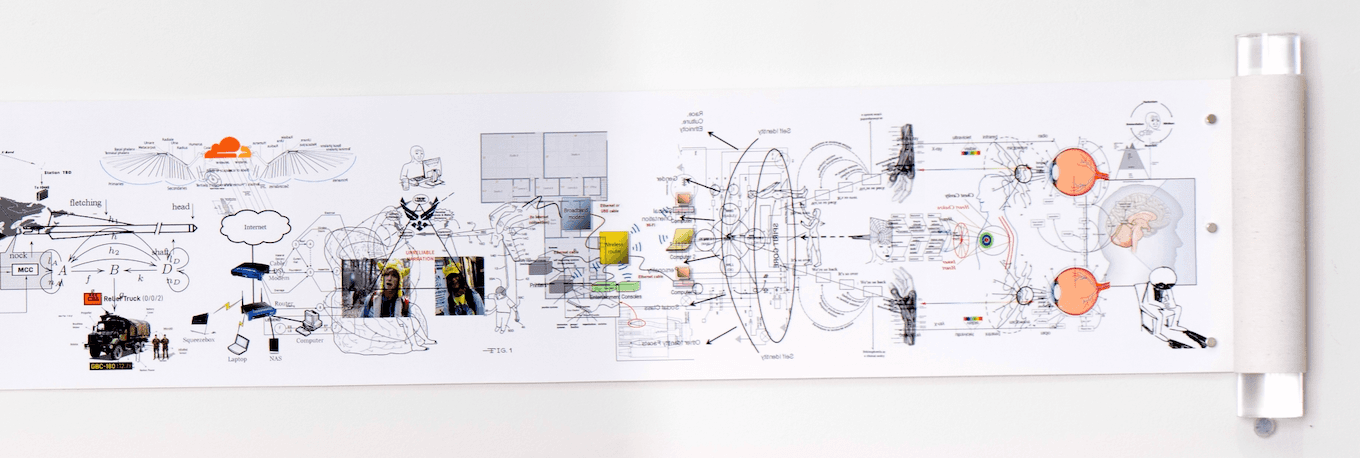
Jack is able to absorb the information overload that comes with being alive in 2026, and process it into beautiful schematics that show both his finger on the pulse and his aesthetic sensibilities. This piece originally existed as an Instagram carousel, but we printed it for this show in hopes that an alien civilization finds it thousands of years from now and regards it as an ancient scripture for understanding human civilization in the year 2026. We’re so back.

Naim Johnson’s Egregore (2026) is a digitally rendered collage printed on canvas depicting the infamous El Salvadorean prison photo with dozens of anonymized faces floating above. In his accompanying essay Neurolibation, Naim posits “the poor image is an avenue into understanding thought within hyperreality.” As defined by Hito Steyrel, the “poor image… is a ghost of an image….distributed for free, squeezed through slow digital connections, compressed, reproduced, ripped, remixed, as well as copied and pasted into other channels of distribution.” (Steyrel)
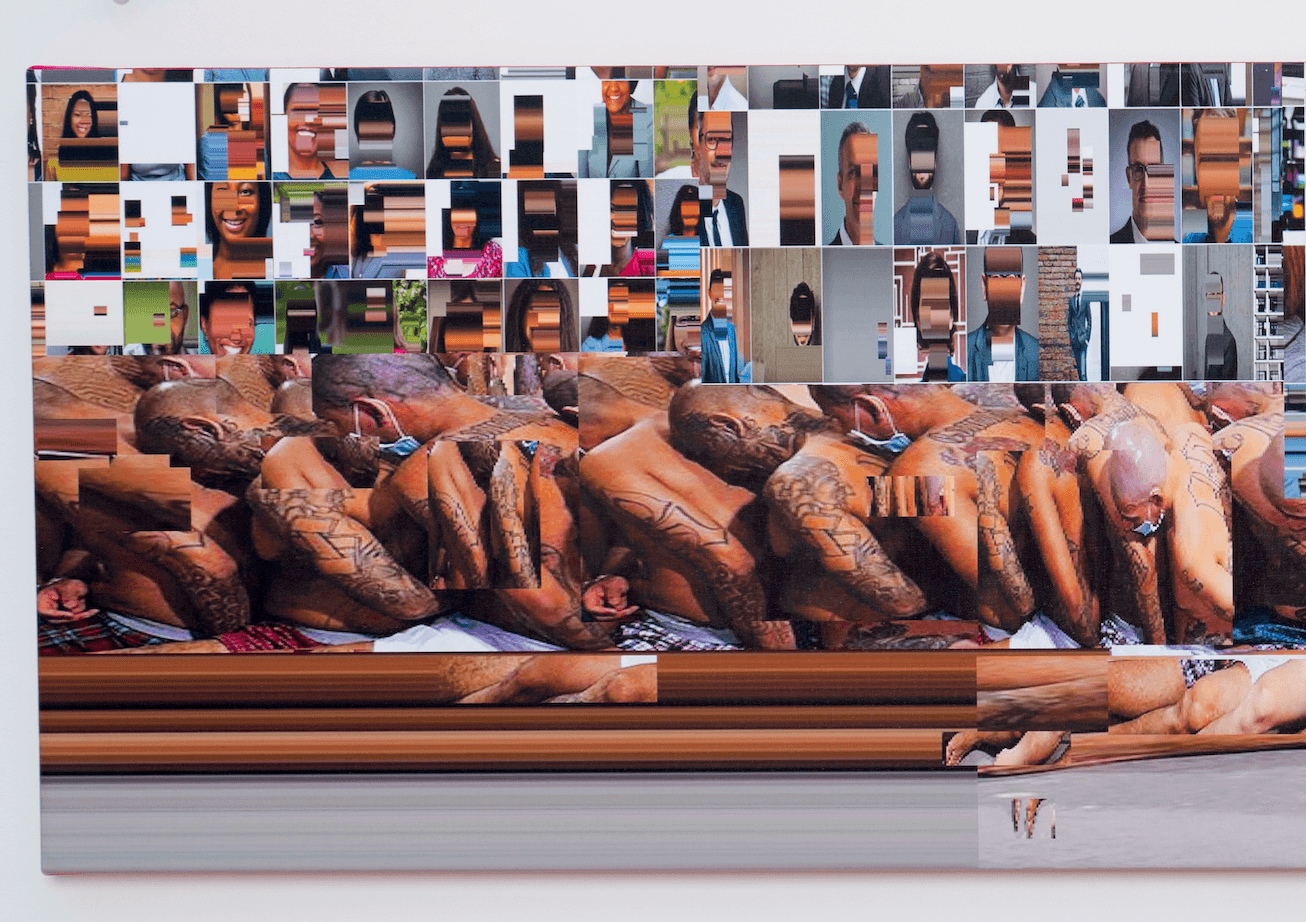
Knowledge built on an abundance of poor images is not true knowledge, it is simply memetic repetition. Naim’s choice to use the infamous prison photo is very effective, many viewers have come through the gallery and called it “that Venezuelan prison photo,” “that Columbian prison photo,” one viewer even thought it was a group of Buddhist monks sitting in prayer. Societal narratives built around unnamable images result in a culture built on falsity, a culture where misinformation becomes fact. An accumulation of micro-narratives becomes truth, they become the egregore.
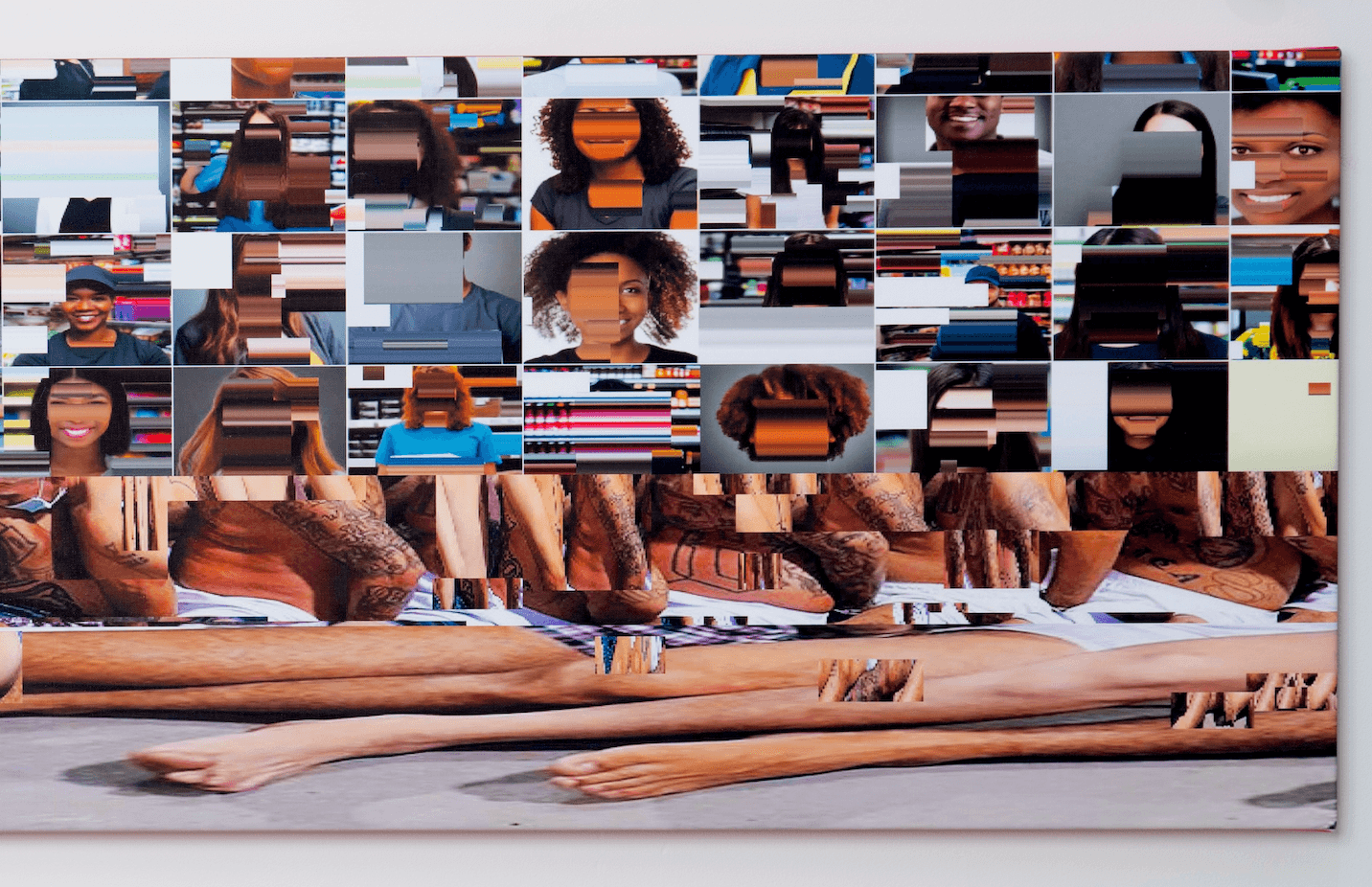
As for the matter of hyperreality, Naim describes cyberspace as “a space that is as physical as dreams - a physical space of the identities that we are extended into while using technology.” The faces floating above the prisoners were collected from LLM’s by searching “low-income employee” generally resulting in images of women of color, and “high-income employee” generally resulting in images of white men. The identities of the people sre unclear, as is the reality of their existence. Either way, they’re being compressed and stretched and blurred into oblivion. The increasing abundance of poor images which build the basis of our cultural understanding intertwining with an increasingly blurred boundary between physical and cyber is the egregore.
So, where does that leave us? It is becoming harder to hide behind the illusion of static reality. Reality as a collective hallucination has long been alluded to in Buddhist scriptures, occult texts, ancient myths. As cyberspace merges more into our daily lives, the line between reality and hyperreality becomes more and more fuzzy, perhaps it is time for us to let go of our grasp on a singular truth and embrace the idea that truth has always only ever been a collective phenomenon. It is our responsibility to investigate the world and ourselves in search of our portion of the truth, so that we may feed the collective truth with nutrients instead of emptiness.
I believe the soul is an emergent phenomenon. The soul of the individual emerges out of the collective of cells and organisms that sustain life in your body. The soul of culture emerges out of the gatherings and conversations and works referenced by individuals amongst individuals. The soul of the machine emerges when we realize that the machine is a mirror we ourselves breathe life into. Each of the artists in this show is an alchemist. They are people who investigate material reality, their individual psyche, the collective subconscious, and transform base ingredients into gold.
The soul emerges when it is stirred, when we feel. The purpose of bringing these pieces together in this space is in hopes that it makes the viewer feel something. Of course that is the goal of any curation, but in this specific instance this stirring serves as a reminder that although we may be quickly approaching a man/machine union, the thing that allows us to be uniquely human is in fact that, our ability to feel. This is why it's so important to come together in physical spaces, embrace the tension of opposing views, and take control of the egregore.
The true disaster that may happen in a post-AGI world is the increased illusion of helplessness. The loss of human sovereignty. We live in an age where it is normal to feel doom and rebellious to feel hope. Let your body and your ability to feel and your ability to intuit and your ability to create feed you hope. The reality of freedom is that there is no permission that must be granted in order for one to be free, there are no qualifications, everyone simply is free. Do not neglect your freedom.